

• Skip to primary navigation
  • Skip to main content
  • Skip to primary sidebar
  • Skip to footer
SketchCop®

SketchCop®

Digital Solutions for Facial Imaging & Identification

  • Home
  • About Us
    • Meet Michael W. Streed “The SketchCop®”
      • High-profile Cases
    • SketchCop® Solutions
  • Solutions
    • Software Apps
      • SketchCop® Software App
      • SketchCop® for the Classroom
    • Services
      • SketchCop® REMOTE
      • Unidentified Remains_ID
  • Academy
    • SketchCop® Academy
    • SketchCop® 1-on-1 – Personalized Forensic Art Training
  • SketchCop® Media
    • Press
      • Press Archives
      • Television, News and Video
      • Podcasts
      • Voice and Print Media
    • SketchCop® Blog
  • Captured Gallery
    • Murder
    • Sexual Assault
    • Kidnapping
    • Deadly Assault
    • Robbery
    • Historical Faces
  • Contact

Michael W. Streed

Happy Holidays from SketchCop® Online Academy

December 21, 2018 by Michael W. Streed


Happy Holidays and Happy New Year everyone! With the holidays quickly closing in, we’ll keep this month’s newsletter short and sweet. So, in the spirit of the holiday time crunch, let’s do a quick year-end review.

SketchCop® Online Academy started about a year ago with zero students and zero newsletter subscribers. Thanks to your support, we now have: 75 SketchCop® Online Academy signups, 69 students and 145 newsletter subscribers.

Once again, many thanks!

I would also like to thank Terri Armenta, our online academy administrator. She is also the owner of the Forensic Science Academy and Forensic Science Academy Online. (https://www.forensicscienceacademy.org/online-courses.html.) Terri helps keep me focused and runs the site like a well-oiled machine.

With all of us working together, I would say we’ve had a successful first year.

Our goal in 2018 was to introduce you to forensic facial imaging through our monthly newsletter. We also launched three online courses.

Looking forward to 2019, we’ve established partnerships to offer you tools for success, specifically digital pen tablets you may purchase for use during upcoming courses.

Starting soon, we’ll be launching product links to purchase a public version of Frontalis® Facial Composite System Software, pen tablets, Corel® Painter Essentials, Corel® Painter 2019 and Adobe® software.

This will allow us to focus more on developing your digital drawing skills, along with the practical aspect of the discipline which includes lessons in communication skills and rapport building.

Who knows? We might even have a hands-on workshop. I’ll have to talk to Terri and see what we can put together.  Either way, 2019 promises to be another year of growth and development for SketchCop® Academy Online. We hope that you’ll remain a part of it.

Thanks again for all your support! Don’t forget, if you have any suggestions, feel free to throw them my way.

In the meantime, please enjoy a safe and peaceful holiday season and we’ll see you all on the other side of the calendar page in 2019!
 

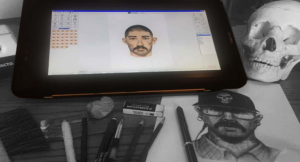
Filed Under: The SketchCop® Blog

Ghana Trip Update – Forensic Facial Imaging Abroad!

November 21, 2018 by Michael W. Streed

Last month, I travelled to Ghana at the invitation of Dr. Richmond Afoakwah, Department Head of the University of Cape Coast’s Department of Forensic Sciences. The university has built a robust program they continue to improve upon with help from the government and numerous grants.

So far, they have built a well-stocked lab with equipment students can use to hone their skills in a variety of forensic science disciplines. I was invited to present my software, Frontalis® Facial Composite System and to introduce them to the digital tools needed to integrate forensic facial imaging into their instructional program.

Up until then, I never travelled outside the continental United States. All I could boast was a couple of trips north to visit our Canadian neighbors. Now I had to get a passport, visa and a series of shots before I could even think about leaving the US.

When I arrived in Ghana, I was taken-in by the beauty of the Atlantic Ocean. I found the people of Ghana to be hard-working, entrepreneurial and kind.

Africa has an abundance of natural resources, many of which are shared with Ghana. While there, I enjoyed a trip to a rain forest, local hangouts and a coastal castle where slaves were processed before being shipped to the America’s both north and south, including the Caribbean.

My host, Dr. Richmond Afoakwah was great! He made sure I had comfortable accommodations and transportatio

He also made sure that I was well-fed with native Ghanaian dishes that I found both delicious and spicy!

Meanwhile, back at the university, I provided a short training program to faculty members interested in learning about using a software-driven approach to create facial composites. They were attentive and eager to learn.

On Wednesday, October 31st, I gave a public presentation titled, Making the Move from Pencils to Pixels, touting the benefits of migrating from analog to digital. It too was well-received and well-attended.

Finishing the business-end of my week, I took part in a faculty meeting where curriculum was discussed for a new degree program.

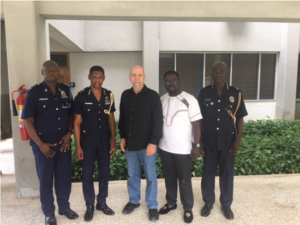
High-ranking officials from the Ghana Police Service also attended. After I spoke about the benefits of integrating facial composites into their investigative protocol, they shared a story about how one of the only times they can remember using a facial composite resulted in an identification and arrest.

In that incident, the suspect was described having a large gap between his upper-front teeth. It was significant enough to call-in an artist to create the facial composite. Hopefully, I was able re-ignite their interest and over time, they will adopt a nationwide approach to creating facial composites using Frontalis® Facial Composite System Software.

With my work pretty much done at that point, the remainder of the week was spent taking in more sights and visiting the capital city of Accra.

Like most major cities, there were historical sights to explore, government offices to see, major traffic snarls to wait patiently in and ONE more, spicy, Ghanaian dish to experience before returning to the US.

Which, speaking of food, I stopped in the UK for a short layover and couldn’t find even (1) fish and chips joint in all of Heathrow Airport! That’s OK, maybe next time. (Thankfully, I did receive a home cooked meal from Mrs. Afoakwah which was worth making the trip!)

But until I return, I will hold fond memories of Ghana, its people and all the new friends I made while there.


Filed Under: The SketchCop® Blog

Writing a book? Creating faces? Beware of writer’s block!

September 21, 2018 by Michael W. Streed

Have you ever woke up in the middle of the night with a great idea?  Only to forget later because you fell back asleep without jotting it down? Maybe you did write your idea down or sketched it out. But when you sat down to flesh it out, you froze because you don’t know how, or where, to start?

Fear not. It happens to everyone. Whether you’re a content creator. write memos at work, or simple just enjoy random sketching or writing short stories for fun, we all get what’s commonly referred to as – writer’s block.

It happened to me when I wrote SketchCop – Drawing A Line Against Crime, During the writing process, my biggest challenge was writer’s block. After a career spent writing millions of words onto tens of thousands of pages of police reports, you would think that writing a book would be a simple task. Not true. Writers blockis something that creators commonly suffer from.

I’ll bet it’s already happened to you. Think back to when you were stuck staring at a blank computer screen. Instead of seeing the words you hoped to write, all you could see was the look of frustration staring back from the reflection of that empty page on your computer screen. It’s that look that makes you want to throw your hands in the air and give up. DON”T! Keep after it.

In my opinion, surrender is NEVER an option. But taking a short break never hurts. Many times, I’ll walk away and give my brain and my eyes a rest. You have to. Taking those occasional breaks and returning with a fresh set of eyes AND a new attitude is the best approach. Walking away from my work is a technique I learned as an artist. It’s something that I still do when I am working on commissioned art, or a forensic facial imaging project.

Here are some helpful hints that might help you overcome writer’s block.

#1 – Just start writing and keep on writing. Let your thoughts and words spill onto the page in their full glory. Don’t worry about poor spelling, poor grammar, or poor sentence structure. I wouldn’t even worry about how it reads. All that matters, at that point, is that you put something down. You can always go back and tidy things up later. Most important is that the idea gets on paper. (Besides, that’s what editors and supportive partners are for!)

#2) Keep a journal nearby. Or keep a pen in your pocket to jot ideas down. Napkins are always handy, or receipts that you keep stuffed inside your pockets. Or maybe, if you’re a tech geek like me, your smart phone or tablet will help. There are many times I have been jolted awake at 2 a.m. and just had to jot that idea down before the moment of inspiration passed.

#3 Create a quiet place to write or draw. Believe it or not, sometimes the noisiest places are the quietest.

#4 Remember – there is no perfect time to start writing or creating a piece of art. You just have to get started…at any place or anytime

I hope those tips are helpful. My best advice is not to panic. Writer’s blockwill happen. You just have to push through it. And before long, your book, or art project, will be finished and you’ll be ready to tackle the next one.

Each of us has a book inside of us just waiting to be written. Maybe, it’s like mine – true crime. Or maybe you have always enjoyed art and wanted to add another option to your law enforcement career. The SketchCop Academy is a great place to begin. The cool thing is – you don’t have to be an artist to create great faces. Only a desire to learn. We’ll teach you the rest.

The best way to begin is to sign up for our monthly newsletter, or maybe even a couple of courses. My recommendation? Get an idea of where you want to begin and then -GO FOR IT!


Filed Under: The SketchCop® Blog

A Forensic Art Renaissance

August 17, 2018 by Michael W. Streed

When I began my career as a forensic artist, the only tools I had was a #2 pencil, a sheet of cheap bond paper and a strong will to succeed. Back then, I knew nothing about cognitive interviewing, facial identification catalogs, victimology or the value of networking. I was a ‘street cop’ who viewed my skills as simply another tool to help capture more crooks.

Over the next four decades, I developed a much broader perspective. I became open to new tools and technology.

Regardless the method used, I found that a facial composite was a helpful tool that brought value to many criminal investigations.

Sadly, I’m not sure that many law enforcement professionals share my viewpoint. Over the last couple of years, I’ve noticed a downturn in the use of facial composites that I can only attribute to the following.

  1. Expansion in the Use of CCTV Surveillance Cameras

Walk down the street and you’ll find cameras mounted everywhere, inside and out. They seem to be everywhere.

In my experience, they provide little in their ability to ID the suspect’s face. But, a facial composite paired with a photo depicting a clothing style and posture, may help lead to an identification.

  1. Citizens Armed with Cellphone Cameras

Like CCTV cameras, they seem to be everywhere. While the photo may be of higher quality, sometimes the person on the other side of the lens doesn’t do a good job capturing the individual’s face.

  1. Over-Reliance on Positive ID Evidence

Positive ID evidence, such as fingerprints, DNA, tool marks, etc. have proven to be accurate identification tools. But, unless you have the suspect’s name, it’s hard to make the connection and locate matching evidence. Obtaining their name, especially through the release of a facial composite, is always good practice.

  1. Lack of Faith in Eyewitnesses

Wrongful convictions based upon faulty eyewitness testimony is never good. Better training can help foster an atmosphere that increases eyewitness accuracy through better retrieval methods.

  1. High Personnel Turnover

Law enforcement is experiencing a high-turnover rate. Experienced investigators are reaching their retirement ceiling. Some investigators fail to brief incoming personnel about resources available to them. This includes forensic artists.

I think it’s time to re-visit the value of using facial composites during criminal investigations. It starts with educating detectives on how a well-constructed facial composite can actually compliment other pieces of evidence.

Those employed with a law enforcement or other government-tasked investigative agencies and those entering the forensic field are the perfect evangelists.

I also think it’s important that this resurgence include computer-savvy individuals with solid interviewing skills, using a software-driven solution with complementing tools and 3rdparty software, armed with proper training. (This would also include updating traditional artists on new methods for creating facial composites using digital technology.)

Part of this paradigm shift would include rebranding the position of forensic artist to forensic facial imaging technician. This will help increase the ranks of those qualified to create facial composites and other related facial examination tasks, even if they lack artistic skills.

I became a forensic artist to help capture more crooks.

Limited artistic skills shouldn’t be a barrier to those who aspire to do the same. If you’re interested, I’ll teach you. All you have to do is sign up for our SketchCop® Academy courses and let the learning begin!

Filed Under: The SketchCop® Blog

Me and the 3 Kings of Forensic Art

July 28, 2018 by Michael W. Streed

The concept of using facial composite assembly systems to create criminal composites is not new.  Over the years, it’s been a hard-sell for companies who dabbled in the technology and tried to market their creations to law enforcement.

In my opinion, facial composite assembly systems, whether mechanical, or software-driven, fell short because forensic artists were rarely involved in product development. The failure of these facial composite assembly systems to gain a solid foothold in law enforcement left forensic artists feeling pretty confident about their own work. Still, I always believed a better solution was out there and I was determined to find it.

During my journey to create a better facial composite software solution, I was thankful to have met and trained under three veteran forensic artists who themselves were involved in developing and implementing forensic facial imaging software programs. These men helped shape my world view of the discipline and influenced me to push the envelope and embrace a technology solution.  They were great mentors and I want to take a brief moment to introduce them to you.

Fernando Ponce – Los Angeles Police Department

Fernando Ponce, a classically trained painter, held the job title – Police Composite Artist for many years before retiring in the mid 1990’s. I first met Ponce in 1979 when I attended a forensic art course he taught. Afterwards, we struck up a friendship that lasted several years. He shared his dream with me of creating a facial composite software program to help officers manually construct composite images. Unfortunately, he was such a perfectionist; he never completed the program. The technology at the time didn’t live up to his strict image standards.

Tom Macris – San Jose Police Department

Tom Macris was trained and educated as a commercial artist before joining the San Jose Police Department.  I was lucky to have met him on a couple of occasions and marveled at his talent

During Tom’s career he partnered with Visatex Corportation to create Compusketch, a facial composite software program.  Although, one time a popular software for law enforcement,  it eventually disappeared off the market.

Horace Heafner – Federal Bureau of Investigation

I met Horace in 1984 during an F.B.I. police artist conference I attended at the F.B.I. Academy.  Horace’s career at the F.B.I. spanned over 40 years. After leaving the bureau, Heafner worked at the National Center for Missing and Exploited Children where he helped pioneer their model Age Progression program.  Horace quickly adapted to the software blending the new tools with his art skills & training to become a sought after expert on the subject of computerized age progression.

All three men pioneered the emergence of technology in the field of forensic facial imaging.  Though passionate about their work, they never allowed themselves to become affected by their own celebrity status. Each of them had enough humility to keep an open mind about developing technology and the role it would play to transform the discipline. I know they transformed the way I approached the discipline. I can only hope that I do half the job they did in moving the yardstick forward in the field of forensic facial imaging.

To learn more, please visit: www.SketchCopAcademy.com

Filed Under: The SketchCop® Blog

How I Made My Own Move from Pencils to Pixels

June 25, 2018 by Michael W. Streed

After years of endlessly sharpening pencils and breathing eraser dust, I’ve discovered a tool that’s made me a better artist. The funny thing is, it’s not much different than a pencil and in the user’s hand, works magic. Why? Because it’s digital

Let me take you back, nearly 40 years ago when I first became a forensic artist. Back then, all I had was a sharp #2 pencil and a piece of cheap, white, copy paper. It wasn’t always the best tool, but even more daunting a task was making image alterations. For example, if you wanted to add a hat, or other artifact to your sketch, you used tracing paper on sheets of acetate. For photos, it was smelly chemicals and Q-tip sticks.

When I first discovered computer graphics in the late 1980’s things were better, but still a bit awkward. To create art in a digital environment required me to clumsily clutch a computer mouse and drag it around my desktop. Unfortunately, the technology just wasn’t there yet.

Once pen styluses with tablets and graphic display devices were introduced, the new technology made much more sense. It was exciting! From the beginning, I believed it would become an indispensable tool that everyone could use.

Although most of us have gotten used to using a mouse, is it really the best tool to use? If you take a moment to think about it, the proposal I’ve outlined below makes much more sense.

We all learned from an early age to write our name using a pencil. Even today, those without artistic skills are likely to sit and doodle during prolonged periods of boredom. And because the pen stylus looks, feels and acts like a traditional pencil, it’s much more intuitive than a computer mouse, making it the perfect tool for artists and non-artists alike!

My flirtation with digital drawing started when I bought a small Wacom pen tablet. It was the perfect desktop size that easily connected to my old laptop computer. I used it for many years, pairing it with Adobe® Photoshop®.

As technology evolved, pen devices became more expensive to acquire for most.

In 2011, I was hired as Baltimore Police Department’s Forensic Artist. Despite my previous experience, I was still an analog artist. Even though I had a desktop computer, I didn’t have the correct software programs. Using a pencil seemed like a primitive solution when compared to what others were already using. But, that’s all I had to work with

Even though it worked well enough, I wanted more. So, in 2015 I finally made my move from pencils to pixels.  Armed with a pen computer, provided by Wacom for evaluation purposes, and the proper software I went digital. My recommendation is that you all go digital too.

On a related note, this month, we’re releasing our latest course – Why & When To Create A Facial Composite. At only $29.00 it’s the perfect course to help you become a more valuable resource for investigators.

Over the coming months, we’ll start offering training to show you how to use this wildly effective tool!

In the meantime, keep reading our newsletters to learn about upcoming training so that you too can become, Stylus Dangerous™!

Filed Under: The SketchCop® Blog

  • « Go to Previous Page
  • Page 1
  • Interim pages omitted …
  • Page 4
  • Page 5
  • Page 6
  • Page 7
  • Page 8
  • Interim pages omitted …
  • Page 11
  • Go to Next Page »

Primary Sidebar

Archives

Categories

  • Capture
  • In the News
  • Press
  • The SketchCop® Blog
  • Uncategorized

Footer

SketchCop Solutions, Inc.

4160 Temescal Canyon Rd.
Suite 401
Corona, CA 92883 USA

  • © Copyright 2026 SketchCop®. All Rights Reserved.
  • • Privacy Policy
  • Created with ✨ by Moxie Design Studios
Scroll Up